
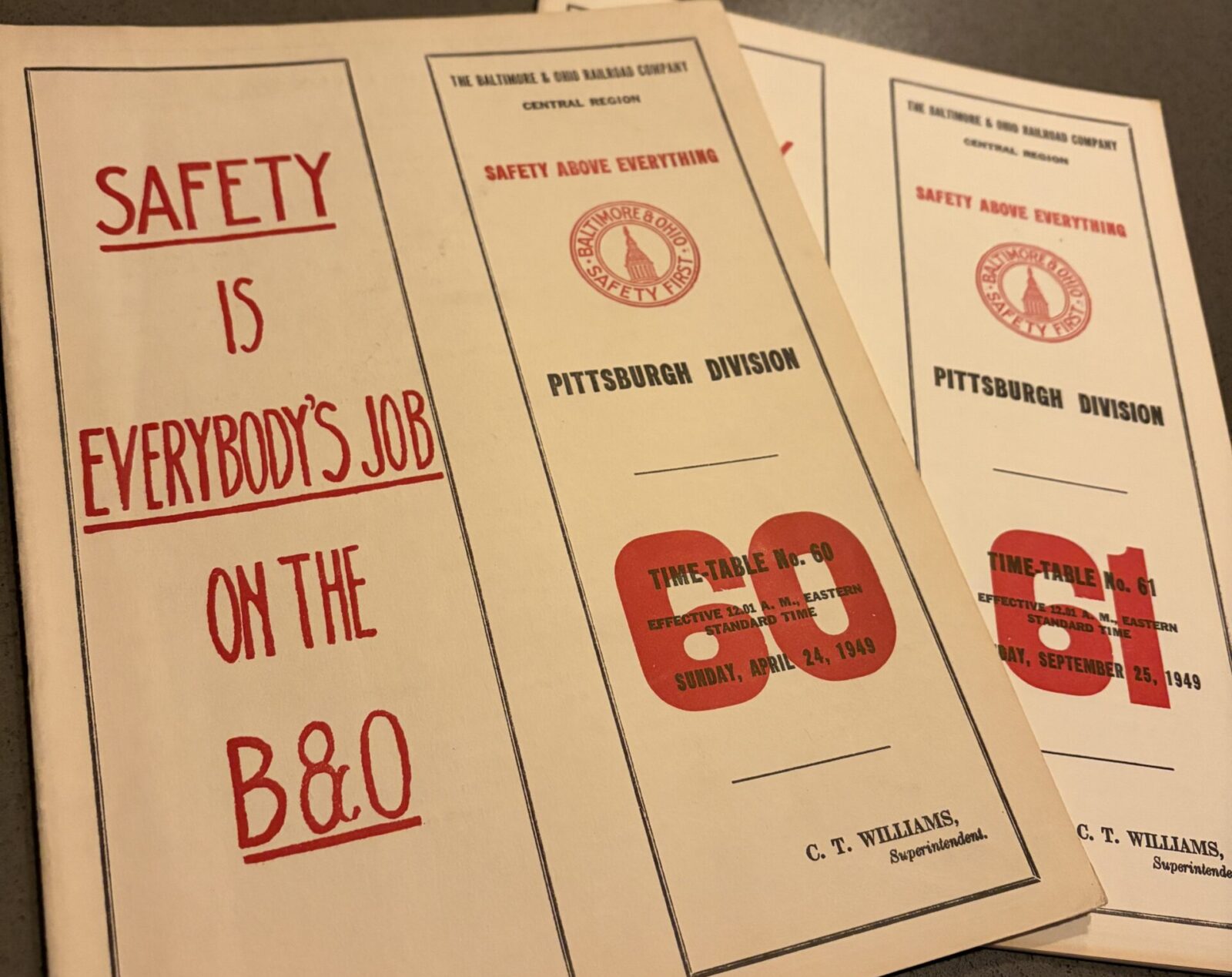
A few years ago, I wrote about B&O Mail & Express Trains 31 and 32 which, for a time, used the same P&LE tracks and station as the B&O through passenger trains I’m modeling. I learned about them from Harry Stegmaier’s book, Baltimore & Ohio Passenger Service, 1945-1971 – Volume 2: The Route of the Capitol Limited. The book features a photo of a double-headed 32 at the P&LE station in Pittsburgh in 1950. The caption notes that, “Until 1948, this train used the stub end B&O station on the north bank of the Monongahela. It was switched to the P&LE routing to avoid the long backup move from Laughlin Junction“. From that, my only takeaway was that I could model it in my time period. I found the consists for both trains (or “close enough” versions) in my B&O Through Passenger Train Consist Book No. 12. from October 1949. Later, I obtained a copy of B&O Pittsburgh Division Employee Time Table No. 61, which is where I finally learned what times 31 and 32 came through Pittsburgh (and McKeesport), since mail trains weren’t listed in public time tables.
I acknowledged at the time that the times in timetable 61 could be wrong for my modeled period (June, July, and August 1949), because it took effect September 25, 1949. I kept a saved search on eBay for B&O Employee Pittsburgh Division Timetable 60, and finally obtained a copy in great condition this month for $28, which showed me the accurate times, plus a surprise which opened my eyes to something I had been overlooking in my planning.
I expected to look up 31 and 32 in the new timetable and simply note the correct times at Pittsburgh if they changed, and that’s what happened when I looked up 31 (westbound). In the summer of 1949, it arrived at 6:20 pm and left at 6:40 (timetable 61 had it arriving 8:15 am). When I found 32 (eastbound), I had expected its time at Pittsburgh to be in italics, which the timetable explains is the indication that the time is for the P&LE station, not the B&O station. I wondered if the lack of italics was a mistake. Then I was confused when I found 32 also listed as a westbound train! I studied the rest of the timetable to try to make sense of it. I re-read Stegmaier’s chapter on the mail trains. I re-read the other timetable (61), where both trains were listed in the ways I expected. I re-read the new timetable (60) and noticed 32’s listing as a westbound train only has two times listed, for Laughlin Junction (1:45 pm) and Pittsburgh (2:00). Then it clicked. If the timetable is correct, there’s a mistake in the book’s caption. 32 being listed as a westbound train, but only between Laughlin Junction and B&O’s Pittsburgh station, means the train is doing “the long backup move from Laughlin Junction” mentioned in the caption. The switch to P&LE routing evidently didn’t start until timetable 61 took effect on September 25, 1949.
Timetable 60 confirms that train 32 goes back to being an eastbound train upon departing Pittsburgh at 2:30, reaching MK Tower at 2:53 and stopping briefly at McKeesport at 2:55 on its way to DC.
Figuring out all of this made me realize I had been overlooking something in my layout planning: the B&O trains that went through B&O’s McKeesport station and did not switch to P&LE tracks at MK Tower like the through trains did. I haven’t gone through them in detail, but there’s a bunch of other trains I had never considered running through McKeesport and not continuing on to my P&LE station. If I were to model them, I’d need a place where the B&O tracks could disappear in the background, since on the prototype, the B&O and P&LE tracks only ran parallel from McKeesport to the P&LE’s bridge across the Monongahela near Carrie Furnace. I’d also need more storage tracks and somewhere else for trains to turn around. None of this sounds appealing, and I keep thinking of the top “given” of my givens and druthers list, which is to focus on the B&O named trains that went through Pittsburgh, a qualifier that doesn’t apply to those trains I’ve been overlooking.
Besides making me aware of that blindspot in my planning, this discovery changed another thing in my planning: the number of baggage cars I’ll need. When I thought 32 served the P&LE station, I needed 11 baggage cars just for trains 31 and 32, including the four cars picked up in Chicago (west staging) and one in Pittsburgh. Now I only need 7 cars for 31, including the one it picks up in Pittsburgh, plus two more for the two day session trains, the Washingtonian and Shenandoah. Seven of those cars would also be used on trains in the night session. The lower number of baggage cars needed is welcome news because, of all types of Walthers B&O heavyweights I see on eBay and Trainz.com, the baggage cars are the rarest and most expensive.