
It’s been a long time since my last post in April 2024. Later that year, life kind of turned upside down, and I moved into a small 1-bedroom apartment. Until more recently, I hadn’t been doing as much modeling as usual, but I continued to add cars and locomotives to my roster, including 64 freight and passenger cars (38 of which are ore cars) and 8 locomotives! After such a long gap since the last blog post, I thought I’d finally take the time to summarize what I’ve worked on since then.
Noir-Inspired Title Images
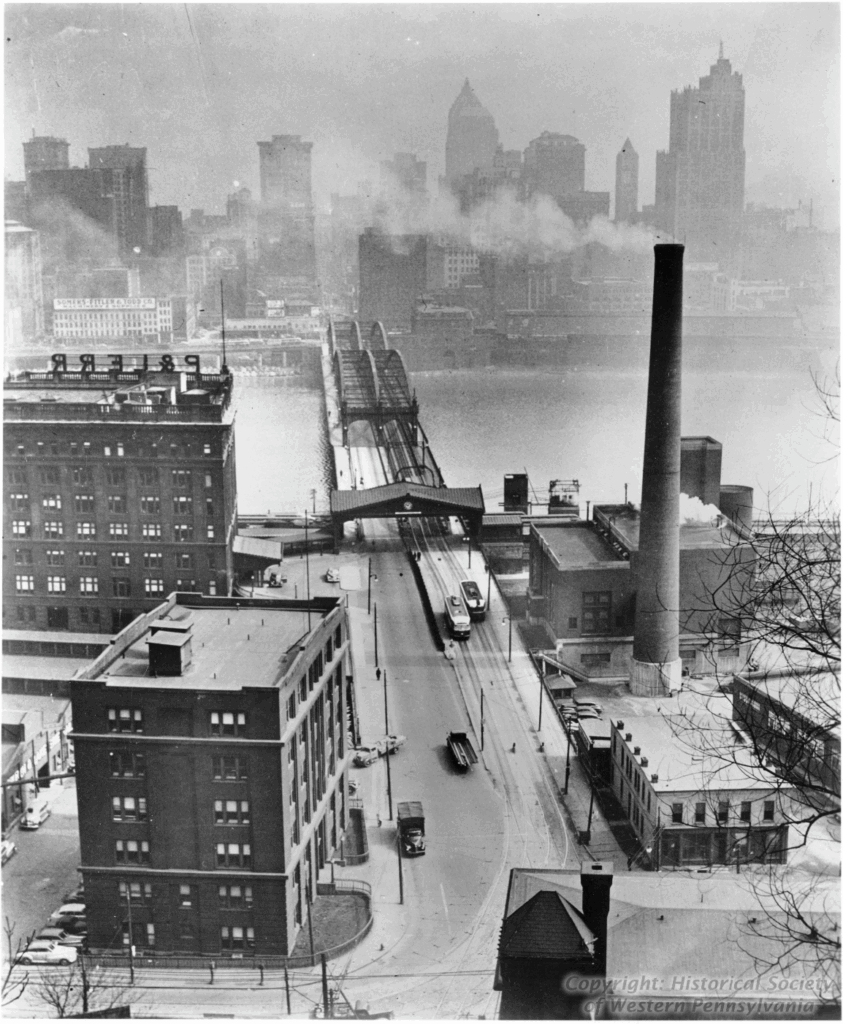
For years, the header of this blog featured just a title and subtitle in plain type over a photo of a pair of Alco PA-1 locomotives on P&LE Train 85 waiting at the terminal in 1949. In June 2024, I was struck with the inspiration to create a title image for this site and my YouTube channel, inspired by the title screens of classic film noir movies. I made it in Adobe Illustrator using the Adobe font ATF Poster Gothic Round. I created film grain effects in Photoshop and placed it over a photo of Pittsburgh’s skyline as viewed from Mt. Washington above Smithfield Street and behind the P&LE terminal, circa 1949, before smoke control measures had a noticeable effect. When I placed the text over the skyline, the smoke wafting from the P&LE’s power plant lined up just right with the title.
28 More Ore Cars
Before this year, I had just seven ore cars which I had repainted and re-lettered for the Duluth, South Shore & Atlantic, and I had only made ore loads for three of them. At the Puyallup show, I picked up ten more, which I quickly stripped of paint. Two months later, I picked up two more at the Monroe show. After the show, we all went down to The Electric Train Shop in Burien, where I picked up 16 more, for a total of 35 ore cars. The 28 new cars have been stripped and repainted. In November 2025, I bought ten more ore cars at the Boeing Employees Model Railroad Club annual swap meet, for a total of 45 ore cars, which I think will be enough for one train. Unfortunately, the decals I purchased for the first seven cars are now sold out (discontinued?) and I haven’t seen HO scale DSS&A ore car decals anywhere else. I’ll have to design and order some custom decals before this project can continue. I’m trying to think of other white decals I might need for other projects, since the number of ore car decals I need won’t fill a whole decal sheet on their own. Back in March 2025, my goal was to have all of these completed, with ore loads, in time for one of the three visits to Karl’s layout after train shows this season, but I haven’t had quite enough drive to make that happen. Progress is continuing steadily, but like most modeling projects, I’m taking my good old time with this. At some point in the project, I decided to start weathering 19 other freight cars (mostly box cars), which slowed down the progress. As I type this, I’m in the middle of painting the wheelsets for all 64 cars, including making resistor wheelsets for them.
The plan is to model one ore train, which can run south with loads, or north as empties. The ore came from Michigan (beyond the confines of my layout) to steel mills in Pittsburgh. I’m only planning to model part of one mill at most. So, the deliveries of ore would likely take place in a yard or spur in front of some building flats. Perhaps, if removing 45 ore loads between operating sessions is too tedious (it seems like it will be), I may build a separate train of empties in the future. However, if I do, I think I would go with modern models, especially if I can find some painted brown but unlettered, so that I don’t have to paint them or buy new wheelsets, like I’ve been doing with these old Roundhouse ore cars I bought for this train.
NYC/P&LE H10-44 Switchers
In February and May 2024, I obtained two NYC/P&LE Fairbanks-Morse H10-44 switchers, numbered 9100 and 9101, by Proto 2000/Walthers.
9100 didn’t have a factory-installed decoder, so installed a Tsunami 2 decoder with a Nix Trains Decoder Buddy, a drop-in speaker system by Scale Sound Systems, and an additional LED for the number boards so that they can be controlled independently from the headlight. On the prototype, 9100 was originally numbered 8800, changed to 8900 on 5/11/48, and to 9100 on 11/03/49. That’s about three months after my modeled time period, but close enough.
9101 came with a QSI Quantum Q1a decoder, which doesn’t sound as good as the custom job on 9100, but is good enough. On the prototype, 9101 was originally numbered 8801, changed to 8901 on 5/10/48, and to 9101 on 10/31/39. Again: close enough.
In addition to these two H10-44s, my plan is to also roster at least one Alco S-2 (number 8357, 8358 or 8359) and at least one EMD NW-2, in order to depict the variety of switchers on the P&LE in 1949. I think I’ll need at least five switchers: two at the terminal, one each in the west and east staging yards and another one to use wherever needed.
B&O E Units
In May, I obtained a Broadway Limited Imports B&O E6 A/B pair (#61 and 61X) in like-new condition from eBay. This can be used on the Shenandoah, Ambassador, or Capitol Limited. This B unit is unpowered, and these trains are long enough to require a powered B unit, so I’m on the lookout for a replacement. The only powered B&O E6 B BLI made is #58X, so I’ll have to get that one and swap its shell with the 61X shell on the unpowered version I have.
When I purchased the E6s, I also obtained a BLI B&O EB #52 in like-new condition from the same seller. I think he had been running this powered EB with the E6 A. In July, I found an EA #52 to go with the EB #52. This pair can be used on the Shenandoah or Capitol Limited. These models have some shortcomings:
- These are not really B&O EA/EBs. They are Santa Fe E1 A/Bs painted in the scheme for B&O EA/EBs. The most obvious difference to me is the shape of the portal windows. But it’s the closest I can get to B&O EA/EB in plastic.
- The sound was pretty bad out of the box, but it’s much better after removing metal screens from beneath the speakers. Thanks to Doctor Hobby for sharing this easy fix.
- The color of the LEDs is far too cool (blue). It should be much warmer white. I was able to fix this by attaching tiny pieces of amber gel filters to the inside of the shells with Kapton tape, between the LEDs and the lenses for the headlight, backup light and number boards. The class lights would have been a lot more difficult to do this to, so I left those alone. It looks much better now.
B&O Passenger Cars
My last post, in early April 2024, was about switching to Walthers heavyweight passenger cars, instead of the old Athearn cars I had been upgrading. Since then, I’ve added 17 more Walthers, WalthersProto and Walthers Trainline passenger cars to my roster:
- Lightweight coach (2)
- Lightweight streamlined baggage dorm coffee shop lounge
- Heavyweight coach (3)
- Heavyweight baggage (2)
- Heavyweight diner (2)
- Heavyweight 8-1-2 sleeper
- Heavyweight Solarium Observation
- Heavyweight 10-1-2 sleeper
- Heavyweight 12-1 sleeper
- Heavyweight 6-3 sleeper
- 60′ Heavyweight RPO (2)
I bought them from Trainz.com and eBay, except for one which I found at the Monroe train show this year, which was the first time I’ve seen a Walthers B&O heavyweight at any of the three local shows I go to. Unfortunately, it was another 8-1-2 sleeper, and I already had the four I need, but at $40, I couldn’t pass it up. After that show, a bunch of us got lunch at Vick’s Burger Shack again, but it will probably be a while before we can do that again, since they experienced a devastating fire in August. I hope they’re able to rebuild.
First Crack at Boxcar Weathering
In October 2024, I spent about two weeks weathering six 50′ single-door NYC and P&LE box cars, which I had purchased as unassembled kits from train shows here and in Pittsburgh in 2023 and 2024. Before weathering them, I installed a 10k resistor to one wheelset per car, for block DCC detection. One of the six cars belonged to Karl. I think he got it as a door prize at one of the train shows and offered it to me, but its paint scheme was too modern for my 1949 time period, so I offered to assemble and weather it for him to run on his layout (Milwaukee Road with a flexible 1950+ era) as a car in interchange service. These are old Proto 2000 kits, which are a tedious to assemble. The separately-applied parts like break gear, grab irons and ladders are very delicate, and even though extra grab irons and steps are provided, there have been times when I’ve broken all of them during assembly and had to make replacements from phosphor bronze wire. The stirrup steps break off very easily during and after assembly. It’s insane how fragile they are.
Building 5 Interior Details
I started working on Building 5 in January 2020, but most of the work was completed in late 2023 and early 2024. In September 2025, I bought desks and chairs (2 ea.), shop cabinets with drawers (4) filing cabinets (6) bookcases (4) from Inter-Action Hobbies. These will be used in the book shop on the first floor and the law offices on the second and third floors. I immediately assembled the filing cabinets, shop cabinets and the first desk and chair set. They’re ready for airbrushing. But as of today, I haven’t touched this project since 9/21/25.
Reconsidering Lighting Voltage
Other than Building 1, which is powered by an Arduino Uno, the buildings I’ve completed so far are powered by 3 volts DC. That seemed logical, since it allowed me to wire the LEDs without resistors, but now it appears that was short-sighted. That works fine when dealing with just one or a few buildings on the workbench, but when they are ultimately installed on a layout with many times that number of buildings, with a much greater length of power bus wires, the voltage drop over that distance could be enough to cause the LEDs to not light. If the buildings are designed to run on 12 volts (with appropriate resistors in the building internal wiring), there will still be plenty of voltage to light the LEDs even with a voltage drop over a long distance. Additionally, a 12-volt supply can power the Arduino for Building 1 or any future buildings that might use an Arduino, which runs on 7-12 volts. A third benefit is that when using a 12-volt supply, there’s a wider range of control when using resistors to dim LEDs to different levels within a building. In a 3-volt system, because you’re so close to the LED’s “turn-on” threshold, adding even a small resistor can make it flicker or shut off entirely. So, starting with Building 5, I’ll go with 12 volts, and I’ll add resistors to the four buildings that currently run on 3 volts, so that everything can run on 12.
11 Structure Kits in the Queue
I decided in 2023 or 2024 that I would not start another building project until I complete the ones that are partially complete, which now is down to just Building 5 and Building 6, the scratch-built Atlantic gas station. I encountered some problems with the gas station, and I intend to start over from scratch and do some things differently, such as not using the craft cutter, which rounds off the corners as it cuts through the thicker styrene sheets. It’s fine with thinner material, but once you reach its maximum recommended material thickness (which I can’t remember right now what that is), the corners get rounded off. I’ll probably start the next building project after Building 5 is complete, because I like to have at least two going simultaneously, so that I can alternate between projects when I get bored or frustrated with one. That way, I can continue enjoying working on projects, and when I eventually get back to the one that was causing frustration or boredom, I’m approaching it with fresh eyes, I’m more likely to have a solution to the problems I encountered, and I have a refreshed interest an enthusiasm for working on it again. I currently have 11 other structure kits in the queue to choose from when I’m ready to start Building 9:
- DPM Modular Victorian Style Storefront
- DPM Carr’s Parts
- DPM Seymour Block
- DPM Robert’s Dry Goods
- DPM Goodfellows Hall (potential jazz club with ballroom dancing upstairs)
- DPM 1st National Bank
- Walthers Cornerstone Jewelry Store (potential bakery)
- Walthers Cornerstone Don’s Shoe Store
- Walthers Cornerstone Flowers by Terry
- Magnuson Models Grain Exchange (flat)
- Magnuson Models The Gemini Building
It’s likely that I’ll start the Goodfellows Hall building next, because I already have figures for a jazz band and swing dancers.