
Big Picture Plans

The one big question in my mind at the early stages of planning a model railroad is which railroad or railroads to model in my next layout. The answer to that question depends on the answers to three other questions.

  • What locations to model
  • What time period to model
  • What industries to model

In order to create a model of a time and place that is historically accurate, or at least plausible to a degree that I’m happy with, I have to select a combination of location, time period, industries, and railroad(s) that are at least historically plausible.

Locations

This question, for me, comes down to choosing between modeling the Northeast (PA, MD, WV, NY) or the Pacific Northwest (WA, OR, ID, MT). After spending my first 27 years in Pittsburgh, and the rest so far (14 and counting) in Seattle, I have an affinity for and familiarity with the scenery in those those two regions.

Time Period

Without question, there will be steam on my next layout. So, that ends the time period at about 1950-1956, depending on the railroad. I like the look of the early diesels, particularly F units, so I’m open to modeling the transition …
Continue Reading →

Highball!

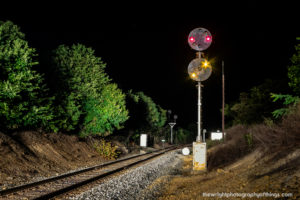
Diverging Approach Signal Indication

I created this blog to document the planning and eventual construction of my next model railroad, to be built sometime in the distant future, when I have the necessary space. My last layout, built around 2002, was small (4×8) and mountainous, but I stopped construction and gave it away when I moved across the country in 2004. There is no space in my current home for a layout of any size, but I’ve come to realize that I can still enjoy the hobby without building a layout, by learning new skills and working on small projects that can be incorporated into my future layout.

Some of the first projects I have in mind are building my own electronic circuits for automated signaling systems with block detection, grade-crossing circuits, scratch-building signals, and practicing airbrushing and weathering techniques. When it comes to practicing techniques, I could purchase some cheap structures, rolling stock, or locomotives on eBay, just to practice on them and then re-sell on eBay when I’m done with them. If my scratch-built signals turn out well, maybe I could make extras and sell them on eBay.

Before I can make certain decisions for my next layout, …

Continue Reading →